
Skip to a section
The old covering comes off and a new one goes on. That means tiles, slates, or a flat-roof system, usually with a new membrane, battens and the lead that belongs with them. People start looking when water is getting in, tiles are in the garden, or a patch has already failed twice.
It is the right job when the covering itself is finished. It is not the answer to one slipped tile, a blocked gutter, or a stain from a single storm. A good roofer will say if a repair is enough. We do not decide that from a form.
Get new roofs quotes for your home
Find out which solution could be right for your property. One enquiry, passed only to companies who cover your postcode.
Problems homeowners run into
Water keeps coming back after rain
A patch that returns, or several patches in different rooms, usually means the covering, the flashings or the felt has failed in more than one place. Another tube of sealant is not a roof.
Tiles are slipping, cracking or lying in the garden
A few can be refixed. When they are failing across the slope, the nails or the battens are tired as well. Replacing them one by one is a long repair of a roof that still needs replacing.
The loft is wet and the bedrooms smell damp
Daylight through the felt, stained timbers, or mould on the insulation means water has been getting in for a while. A new covering is the job when the roof itself is the source, not a one-off storm.
A survey has flagged the roof
Buyers, insurers and surveyors notice sagging, a perished ridge and a flat roof that holds water. A failed covering is what they are looking at, and a patch rarely satisfies the next person who goes in the loft.
What the work actually is
On a pitched roof, a replacement usually means scaffolding, stripping the old covering, checking the timbers, and fitting a new underlay, battens and covering, then making good the ridge, hips, valleys, eaves and any lead against walls or chimneys. The loft insulation is a separate layer at ceiling level, unless you are also converting the space.
On a flat roof, the system might be a reinforced membrane, a single-ply rubber, a fibreglass laminate or a liquid coating over a sound deck. Those are different products with different details at the edges and outlets. The right one depends on how people use the roof, how it drains, and what is underneath.
The useful quote tells you the covering, what happens to the lead and gutters, whether any timber is included, and how long the scaffold stays. A price with none of that is hard to compare with a price that includes all of it.
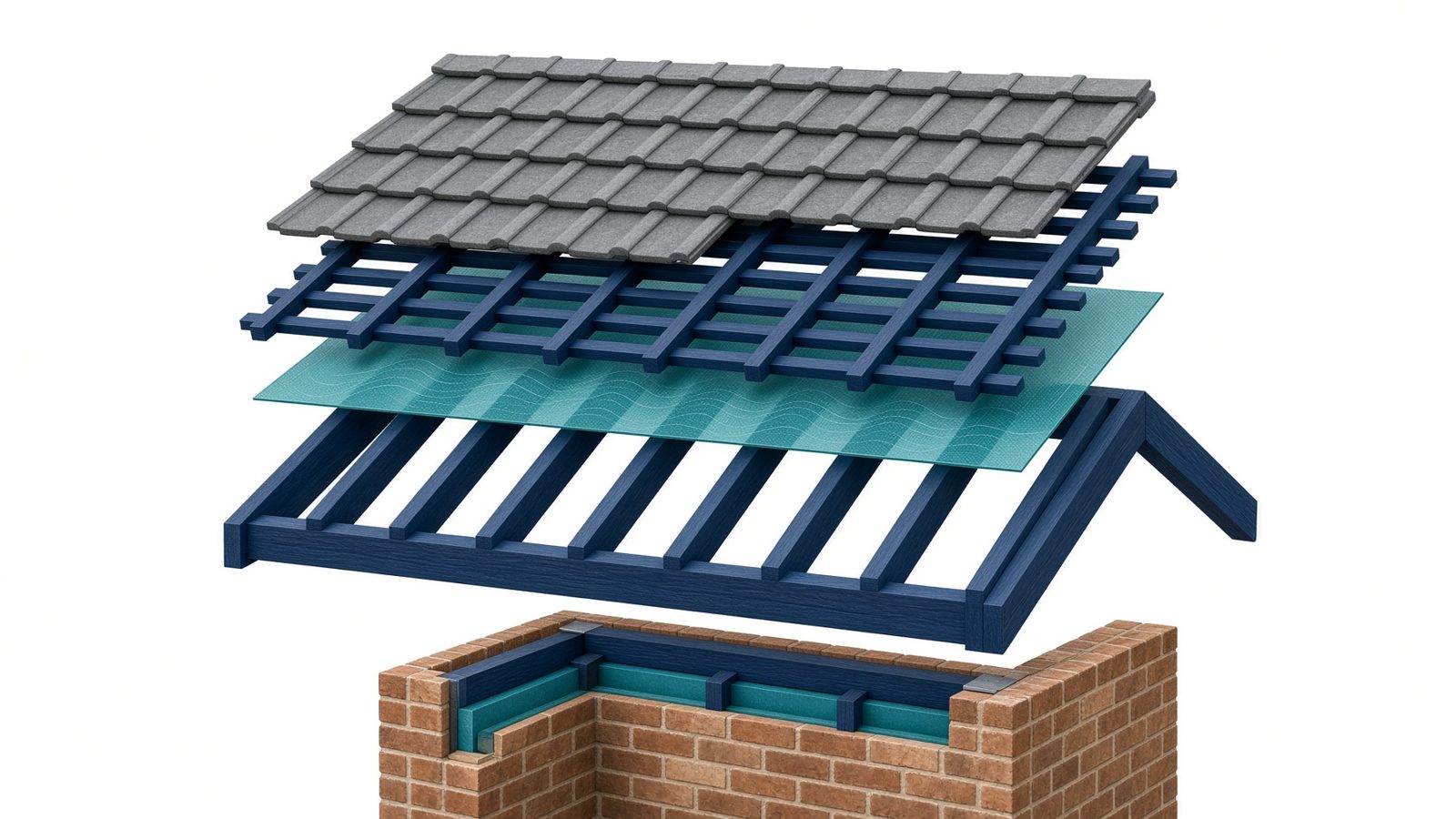
What a new roof is made of
Tiles, battens, a breathable membrane, then the rafters. A replacement is those layers, not a coat of paint. The timbers usually stay. They are only replaced if they are damaged.
Features, and what you gain
Pitched, slate and flat roofs
Concrete tile, clay, slate and flat roofs are all part of the work. The roofer should say which covering suits the house, and whether the structure is happy with the weight.
It increases the value of your home
A sound, tidy roof is one of the first things a buyer and a surveyor look at. A new roof increases the value of your home.
A new look with leaks and storm damage
Tired tiles come off and a new covering goes on. If water is getting in now, or a storm has done the damage, say so. That is part of the job, not a separate problem you have to solve first.
You speak to the roofers, we do the searching
You describe the roof once. We find roofers who cover your postcode and meet the 4-star rule. You still choose who to speak to.
Why a new roof is worth pricing properly
A replacement covering is a building job, not a tin of coating. The roofer should say how the work sits with building regulations for your address, especially if the weight of the tiles changes or timbers need replacing.
A dry, sound roof stops you heating a house that leaks the warmth straight out, and it protects the rooms and the timber underneath. That is the saving that matters, more than a slogan.
Ask what workmanship guarantee the company gives, and what the covering manufacturer guarantees. Get both in the quotation before you decide.
Tell us tile, slate or flat, and whether it is leaking now. One enquiry is enough. We pass it only to roofers rated 4 stars or above who cover your postcode.
Compare your options
Take the first step towards improving your home. Tell us the property and we will match the enquiry.
Options, and the differences
None of these is automatically the right one. The company should say why a product suits this property, not just which one they prefer to fit.
Concrete interlocking tiles
Common on post-war UK houses. They are robust and widely available. A new tile may not match the faded colour of a neighbour’s 30-year-old slope, which matters on a terrace if only one side is being done.
Clay tiles
Often on older houses. They look different from concrete and can be the right match for a street. They need a roofer who is used to that covering, especially handmade or peg tiles.
Natural and artificial slate
Natural slate is thinner and often heavier to handle. Fibre-cement slate is the usual alternative when you want the look with a different product. Neither should be mixed at random with the other on the same slope if you care how it weathers.
Flat-roof systems
Felt, EPDM rubber, GRP fibreglass and liquid membranes are all used on garages, dormers and extensions. Rubber and fibreglass are often chosen where people want fewer joints. The deck and the outlets matter as much as the brand name.
Is this right for your home?
Often a good fit
- Coverings that are failing across the slope, not just in one patch.
- Roofs where repairs have already been repeated and have not held.
- Flat roofs with a tired system or a deck that has started to fail.
Pause before you book it
- A single slipped tile, a cracked flashing, or a gutter joint. Ask for a repair quote first.
- A sound roof you only dislike the colour of. A coating or a clean might be the smaller job, if the covering is still doing its work.
- A structure with spread, sagging or rot that nobody has looked at. The covering quote is premature until the timber is understood.
What homeowners can expect
The exact visit varies by company and by property. This is the shape of the job, not a promise that every provider works the same way.
- 01
You tell us the roof you have
Tile, slate or flat, whether it leaks, and whether you think it is a repair or a replacement. “Not sure” is a valid answer.
- 02
We match roofers
Companies who cover your area, offer roofing, and meet the 4-star rule.
- 03
They inspect
From the ground, from a ladder, or from the loft. A full strip should not be priced blind if the timbers might be rotten.
- 04
They say repair or replacement
If they recommend a new roof, ask why a repair will not hold. If they recommend a repair, ask what is being left in place.
- 05
You compare quotations
Look for scaffold, underlay, battens, covering, lead, ridges, gutters and waste. Missing lines are not a bargain until you know who is paying for them.
- 06
The work
Pitched roofs need scaffold and a weather plan. The exact days depend on the size, the weather and what they find underneath. That varies by provider.
- 07
Afterwards
Ask what guarantee the company offers and what it excludes, such as storm damage or later alterations. That guarantee is theirs, not DwellUp’s.
Happy with the brief?
Get a free, no-obligation quote. You decide who to speak to, and whether to go ahead.
Questions homeowners ask
Do I need a new roof or a repair?
You need a repair if the fault is in one place. That might be a few slipped tiles, a cracked flashing, or a blocked valley. You start thinking about a new roof when the covering is failing across the slope, the membrane or battens are gone, or repairs keep coming back. A roofer should look before either quote is treated as final.
What are the signs a UK roof is ready to replace?
Widespread slipped, cracked or porous tiles, rusty fixings, a ridge that has opened, daylight through the covering, or a flat roof that is soft or holding water. One missing tile after a storm is not the same list.
What is the difference between tile and slate?
They are different coverings with different weights, laps and fixings. A house built for slate is not automatically right for a heavy concrete tile, and the look of the street may be part of the decision. The roofer should say if the structure suits the covering you want.
Can you replace a flat roof?
Yes. Felt, rubber, fibreglass and liquid systems are all common in the UK. The quote should say which system, whether the deck is included, and how the edges and the outlet are detailed.
What does a typical reroof include?
On a pitched roof you should expect scaffold, a strip, a check of the timbers, underlay, battens, the new covering, and making good the ridges, hips, valleys and leadwork. Gutters are sometimes extra. If it is not written down, ask.
Will I need scaffolding?
Almost every full pitched-roof replacement needs a scaffold, both for safety and to protect the walls. Be wary of a very low quote that does not mention it.
Can a roof be replaced in winter?
Often yes, with a plan for covering the roof if the weather turns. Some days will be lost to rain or high wind. Ask how the company protects an open roof overnight.
Do I need building regulations approval?
Replacing a covering like-for-like is not always a controlled job, but structural changes, a change in weight, or insulation upgrades can be. Rules also differ if the building is listed. Ask the roofer what applies to this roof rather than assuming either way.
Should leadwork and gutters be in the quote?
If the lead against a chimney or wall is split, or the gutters are finished, leaving them out means the new covering still meets an old weak point. Ask for those lines to be included or clearly excluded.
Does DwellUp employ the roofers?
No. The quotation and the work come from the roofing company. We introduce you to firms who cover your postcode and meet our rating rule. You decide who to instruct.
Why request the quote through DwellUp?
DwellUp does not fit the work and does not set the price. We introduce you to companies that are active, cover your postcode or work nationwide, offer this service, and hold at least 4 stars on Google Reviews or Trustpilot. You choose who to use. There is no fee from us to send the enquiry, and no obligation to go ahead.
Our offer
£100
Get £100 on us
£100 off your next home improvement upgrade when you enquire through DwellUp.
Ends 19 December 2026
2 years
Workmanship warranty
We are confident in the companies we introduce, so their workmanship is covered for 2 years.
Included, at no cost
The same jobs come up in terraces, semis, bungalows and newer estates. We do not run a different service for each town. The match is your postcode, the trade, and the rating rule. If you want the fuller picture, read why choose us.
Start your new roofs enquiry
It takes a few minutes. You can add another service before you send it.